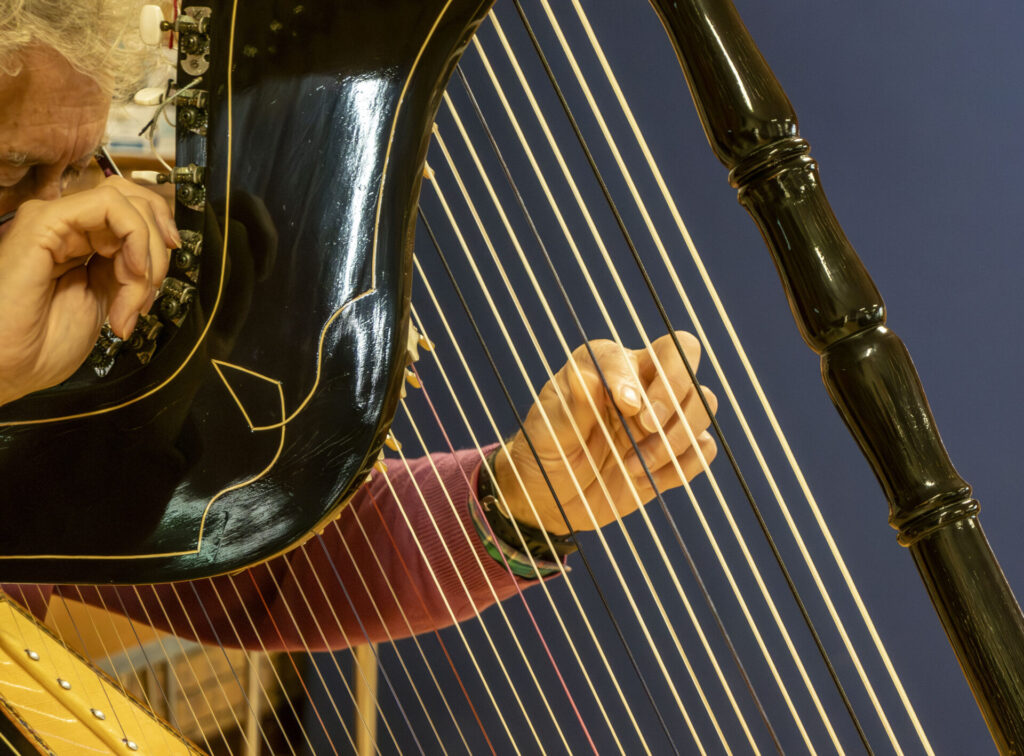
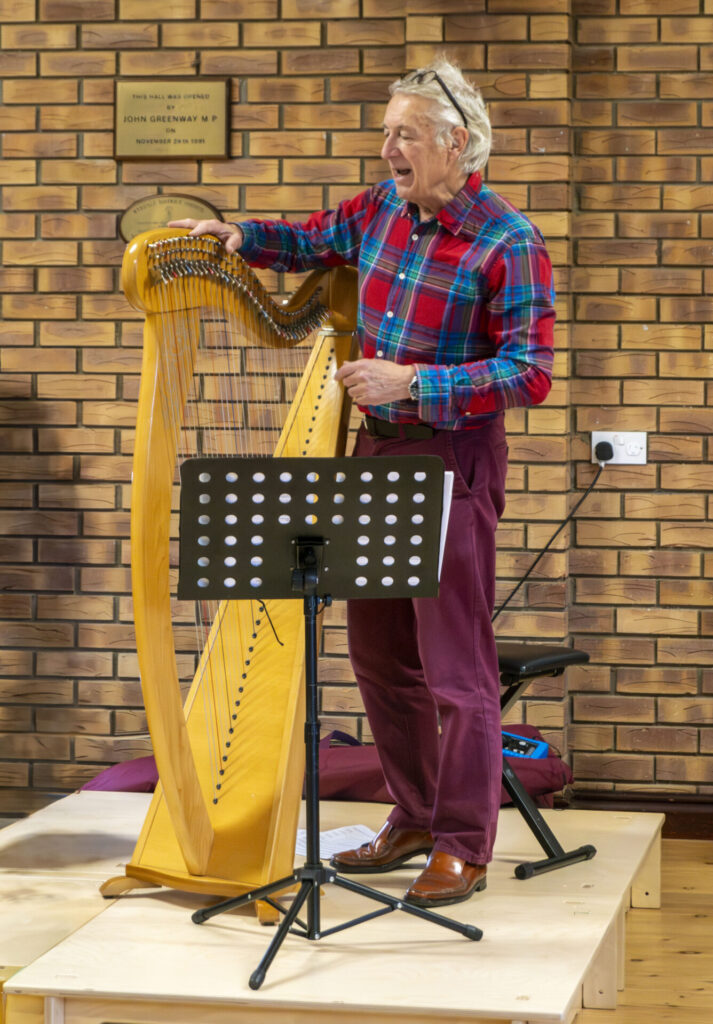
What a joy this meeting was – John brought along two of his harps a Celtic and a Paraguayan one – the former played in more classical style and the latter which is much lighter – with around 80 strings that go through the centre of the neck rather than the side - has a more percussion sound.
John interspersed different compositions with some of the history of the harp and transported us to numerous countries with his playing.
We were informed that of the four elements we recognise – earth/water/air/fire – the harp covers the air element. This comes from the time when it was believed that we descended not from apes but from the heavens. When we became earthbound we lost the ability to hear heavenly music but the harp was provided for us to be able to re-produce the heavenly sounds we missed.
As the harp is the instrument of the angels only special people were allowed to play one – a church/monastery dignity, royalty, or a noble. The harp is one of the oldest instruments still being played, the earliest from around 3000BC. John mentioned just a few notables known to have played the harp – from biblical times, King David, to 7th century Caedman who lived at Whitby, King Alfred the Great, Henry VIII, Anne Boleyn, James 1st/6th, Marie Antoinette.
The Chinese have a different approach to the Western world in that they have five elements (they include Metal). For the Chinese 5 is a very important number – representing not only the elements but also the human body – five fingers, five toes, and when shown like Pentagram – two arms, two legs and a head. The Chinese scale is known as a pentatonic scale – five tones. When John played a piece from China it was immediately recognisable as from that country.
The harp is an incredibly versatile instrument – it can play any type of music – and John demonstrated this by playing tunes that evoked Indian, Latin American, Spanish, North American, Irish, Scottish melodies. It is possible to play pop, soul, blues, folk, flamenco alongside more classical pieces. John’s renditions transported and transfixed us.
There are three ways of playing, using the finger flesh for soft tones, nails for a sharp penetrating sound and fingers for the trill effect. The harp considerably predates the piano, which is in effect a harp on its side – it is therefore possible to play piano pieces using the same score.
There is so much more to say about this talk – we didn’t know what to expect and got the most glorious surprise – which I hope can be repeated at some date, I’m sure John has more stories up his sleeve!